TL;DR: We re-implemented and reproduced the RS-InternVL baseline from the BigEarthNet.txt paper and exceeded the reported results on three of four tasks. We then trained the same multimodal model federated with NVIDIA FLARE across four clients, each holding only its own countries’ data. The federated model stays within 3–8 points of centralized training on the main metrics, matches the paper’s centralized numbers on binary questions and clearly beats them on multiple choice and captioning.
Background
BigEarthNet.txt extends BigEarthNet v2 with text annotations, turning it into a benchmark for vision-language models in Earth observation. Its baseline, RS-InternVL, is InternVL3-1B extended with two extra encoders, one for Sentinel-1 radar and one for Sentinel-2 multispectral data, next to the usual RGB image. We re-implemented this model from the paper’s description, combining InternVL3-1B with BigEarthNet-pretrained encoders, and fine-tuned it with LoRA, separately for four tasks:
-
Binary questions (yes/no)
-
Multiple-choice questions (land cover types)
-
Image captioning
-
Referring-expression detection (predicting a bounding box for a described object)
Step 1: Reproducing the baseline
The paper describes the core recipe: LoRA (rank 8, alpha 32, dropout 0.1) on the language model, frozen vision encoders, trainable sensor projections, warmup to a learning rate of 1e-4 followed by cosine decay, and one epoch per task. Several settings are not reported, however: batch size, optimizer and weight decay, numerical precision, which layers receive LoRA, image preprocessing, decoding settings, and exactly how BLEU-4 and detection mIoU are computed. We filled these gaps with standard choices: AdamW without weight decay, effective batch size 16 (4 GPUs × 4), bf16, LoRA on all attention and MLP projections, greedy decoding, and corpus-level BLEU-4. All results in this post, centralized and federated, are on the paper’s held-out `bench` split, using exactly the same samples, decoding settings and random seed (42) for every model.
| Task | Metric | Paper | Ours (centralized) |
|---|---|---|---|
| Binary | Accuracy | 73.29 | 77.32 |
| Multiple choice | Accuracy | 51.49 | 78.32 |
| Captioning | BLEU-4 | 34.04 | 44.13 |
| Referring detection | mIoU | 65.84 | 56.56 |
We exceed the reported baseline on three of four tasks; the largest gain is multiple choice (+27 points). For detection, the paper reports a single number. We found it important to split it: when the question gives a hint point inside the target, our model reaches 77.70 mIoU, but in open search without a hint it reaches only 35.57. Since the paper doesn’t give that split or all hyperparameters, we treat its numbers as a reference point rather than an exact target.
What is federated learning?
Federated learning trains one shared model on data that never leaves its owners. A central server coordinates the training in rounds:
-
The server sends the current model to every participant (a “client”).
-
Each client trains it for a while on its own data.
-
The clients send back only their updated model weights, and the server averages them into the next shared model (FedAvg, weighted by how much data each client has).
Only model parameters travel; images and labels stay where they are. The catch: when the clients’ data differ (“non-IID”), their updates pull in different directions, and the averaged model can end up worse than one trained on all data pooled together. With parameter-efficient fine-tuning (LoRA), the exchanged update is small: here about 26 MB per round instead of the full 1.1-billion-parameter model.
Step 2: Going federated with NVFlare
-
4 clients. Each holds a disjoint set of countries: (1) Finland; (2) Portugal, Belgium, Luxembourg; (3) Ireland, Serbia; (4) Austria, Lithuania, Switzerland, Kosovo. Every client sees different landscapes, seasons and land cover, a realistic non-IID split.
-
NVIDIA FLARE (simulator mode) on the HoreKa 2 HPC system at KIT, one H200 GPU per client.
-
FedAvg over 20 rounds. Each client trains on a new slice of its own data every round, so over the whole run every sample is seen exactly once, as in the centralized run. The learning rate follows one cosine schedule across all rounds, the same shape as centralized training.
-
Only the trainable parameters travel: the LoRA adapters and the two small sensor projection layers, about 26 MB per round. Images never leave a client; each site loads its own GeoTIFFs locally.
| Task | Metric | Centralized | Federated (4 clients) | Gap |
|---|---|---|---|---|
| Binary | Accuracy | 77.32 | 73.91 | −3.4 |
| Multiple choice | Accuracy | 78.32 | 72.38 | −5.9 |
| Captioning | BLEU-4 | 44.13 | 40.15 | −4.0 |
| Referring detection | mIoU | 56.56 | 48.77 | −7.8 |
| ↳ with hint point | mIoU | 77.70 | 73.07 | −4.6 |
| ↳ open search | mIoU | 35.57 | 24.64 | −10.9 |
The federated model, trained without any client ever seeing the others’ data, matches the paper’s centralized baseline on binary questions and clearly beats it on multiple choice and captioning. Detection with a hint point holds up well; open search, where the model must find the object from the description alone, is where federation costs the most.
Where does the federated model lose? BLEU-4 alone doesn’t say, so we also scored each caption field by field. Most of the federated gap is in naming the right country (76% correct vs. 96% centralized) and climate zone (73% vs. 92%); recognising the land cover itself drops much less (F1 61 vs. 68). That knowledge is split across clients, since each one only sees its own countries. Small countries that share a client with others suffer most: Lithuania is named correctly in only 31% of its captions, and is mostly mistaken for Finland, the largest client with a similar landscape.
What does a single site gain from federation?
To see this from one participant’s point of view, we trained the captioning model on a single country’s data only, once for Finland (the largest country, alone on client 1) and once for Portugal (the core of client 2), and compared them with the federated and centralized models:
| Captioning model | Finnish test captions (n=279) | Portuguese test captions (n=210) | Full benchmark (n=970) |
|---|---|---|---|
| Trained on Finland only | 47.69 | – | 30.14 |
| Trained on Portugal only | – | 37.12 | 29.35 |
| Federated (4 clients) | 46.84 | 34.60 | 40.15 |
| Centralized (all data) | 47.18 | 38.66 | 44.13 |
For Finland, joining the federation costs nothing at home: on Finnish captions all three models perform the same (the 95% bootstrap intervals of all pairwise differences include zero), while on the full benchmark training alone falls 10 points behind the federated model.
For Portugal, the picture is different. On Portuguese captions the federated model is 2.5 points below Portugal training alone (95% bootstrap interval −4.8 to −1.3) and 4 points below the centralized model, while pooling all data centrally is at least as good as training alone. Field by field, the federated model not only names the wrong country more often, as it does everywhere, but also recognises Portuguese land cover less well (F1 49 vs. 58 for Portugal alone). Portugal is the only country in the dataset with a dry-summer climate, so its landscapes differ most from the other clients, and federated averaging pulls the shared model away from them. Still, Portugal gains 11 points on the full benchmark by joining, because the federated model is far more general. On captions from the other countries, the Portugal-only model calls every image Portuguese, but that is not the main issue: it also recognises their land cover only half as well (F1 33 vs. 66 for the federated model).
One benchmark image shows what that means in practice: a Finnish lake surrounded by forest.
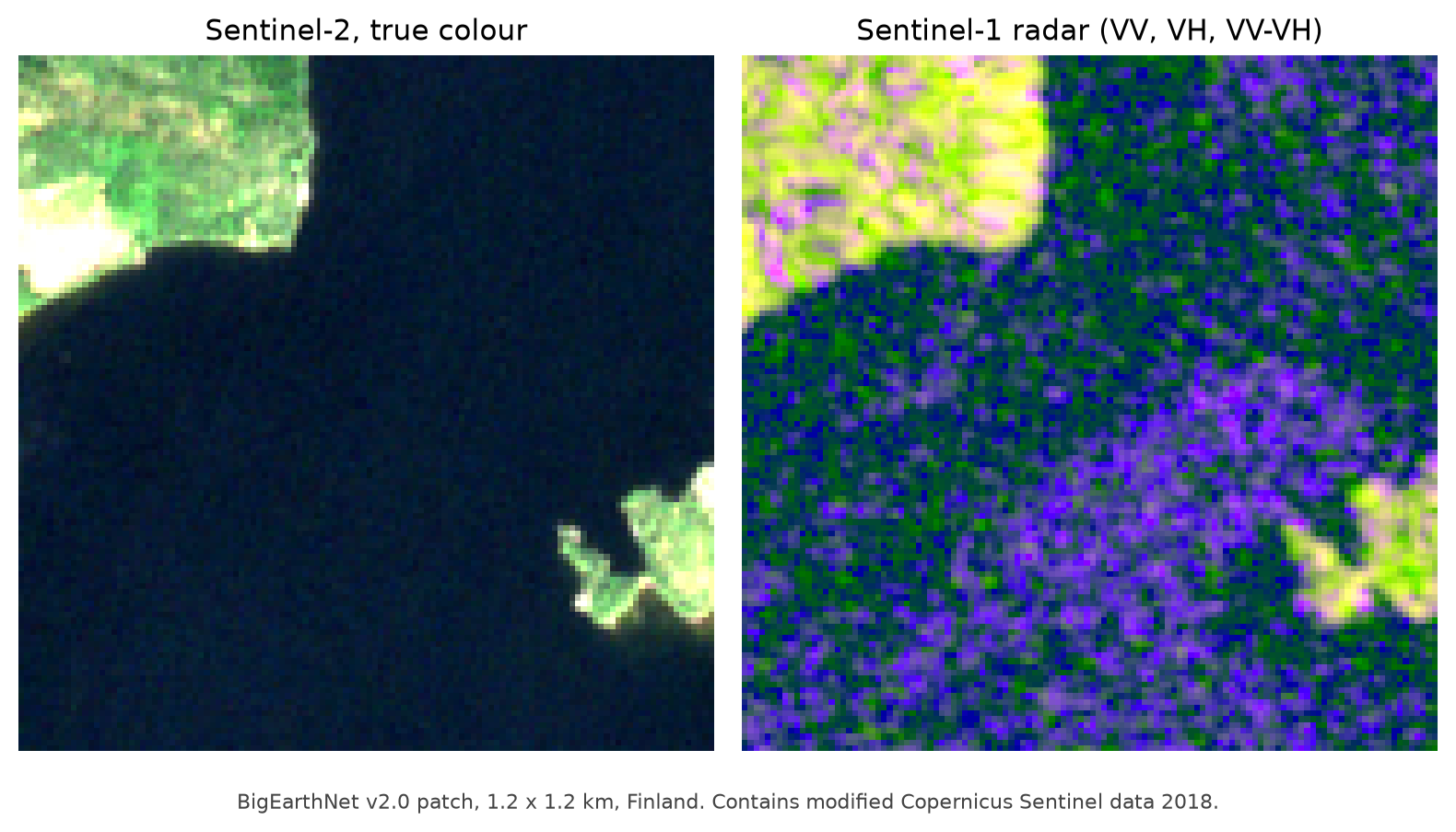
| Caption by | Country | Season | Land cover |
|---|---|---|---|
| Reference | Finland | spring | inland water, coniferous forest |
| Trained on Portugal only | Portugal | fall | marine water, heathland |
| Federated (4 clients) | Finland | spring | inland water, coniferous forest |
| Centralized (all data) | Finland | spring | inland water, coniferous forest |
The Portugal-only model has never seen a Finnish lake and describes it as sea on the Portuguese coast. Both models that learned from all countries get every part right.
In short, a site training alone gets a specialist for its own data; the federated model is a generalist that works across all countries. What that costs at home depends on how different a participant is from the rest: nothing for Finland, a few points for Portugal. Closing that gap, for example by letting each site personalize the shared model, is one of our next steps.
Multimodal models in NVFlare: it works
A practical takeaway: NVFlare handles a multimodal vision-language model with standard components and a moderate amount of custom code (LoRA-aware aggregation, per-round data slicing, and checkpointing to resume after HPC time limits). The model combines three visual inputs (RGB, radar, multispectral) with a language model, but only about 6 million trainable parameters need to be exchanged. Everything else stays frozen and is loaded locally by each client.
What’s next
We are now training a single multi-task model, both centralized and federated, looking at personalization so that every participant benefits, and at a harder and more realistic setting: clients that own different sensors, for example radar-only and optical-only sites.