Evaluating LLM outputs at scale is one of the most practical problems in GenAI work. Human annotation is slow and expensive, and classic metrics such as BLEU or ROUGE say little about whether an answer is actually correct, helpful, or well-reasoned. A popular alternative is LLM-as-a-Judge: using one language model to score or compare the outputs of another.
A question that comes up often is: does the judge have to be a stronger model than the one being evaluated? This post looks at what the research says, both for and against, and ends with a practical checklist for setting up a judge you can trust.
Where the idea comes from
The approach was popularised by Zheng et al. (2023). They showed that a strong judge (GPT-4) agreed with human preferences more than 80% of the time, roughly the same level at which human annotators agree with each other. That result made LLM judges a credible, scalable substitute for many human evaluations.
The same paper also documented the main weaknesses of LLM judges:
-
Position bias: preferring the answer shown first (or second).
-
Verbosity bias: preferring longer answers, even when they are not better.
-
Self-enhancement bias: preferring answers produced by the judge itself.
Why a stronger judge often helps
For hard tasks such as multi-step reasoning, mathematics, code correctness, or subtle factual errors, a judge that cannot solve the problem may also fail to notice when an answer is wrong. In these settings, using a judge at least as capable as the evaluated model is a sensible default.
Why a stronger judge is not strictly required
Several results show that raw model size is not the whole story:
-
Judging can be easier than generating. When the judge is given a clear rubric and a reference answer, it only has to compare, not solve. Kim et al. (2023) trained Prometheus, a 13B open model specialised for evaluation, which reached human agreement comparable to GPT-4 under exactly these conditions.
-
Several small judges can beat one big judge. Verga et al. (2024) proposed a Panel of LLM evaluators (PoLL): a jury of smaller models from different families. The panel matched or outperformed a single GPT-4 judge, showed less bias, and cost considerably less.
The bigger risk: using the same model as judge
Panickssery, Bowman & Feng (2024) found that LLMs can recognise their own generations and tend to rate them higher, and that the strength of this self-recognition correlates with the strength of the self-preference. In practice, this means evaluating a model with itself (or a close sibling) can inflate scores, regardless of how strong it is. A judge from a different model family, or a mixed panel, reduces this risk.
Practical checklist from Literature
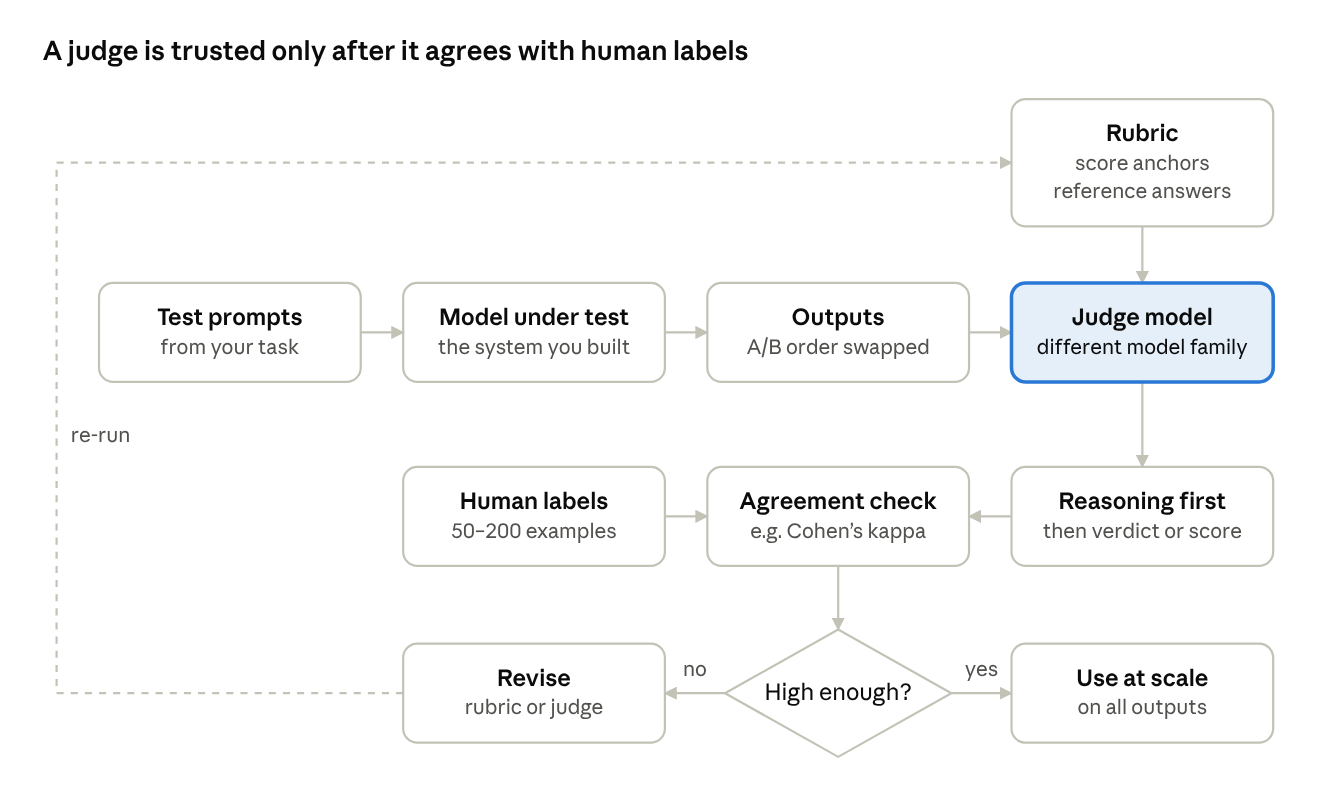
-
Pick a judge from a different model family than the model under evaluation, or use a panel of diverse judges (Panickssery, A. et al.(2024)).
-
Match judge capability to task difficulty. Reasoning-heavy tasks benefit from a judge at least as capable as the evaluated model; simple rubric checks do not (Zheng, L. et al. (2023), Kim, S. et al. (2023)).
-
Write a clear rubric with explicit criteria and score anchors (what a 1 looks like versus a 5). Avoid vague prompts like “rate quality from 1 to 10”. Ye, S. et al. (2023) found that breaking evaluation into specific skills with their own rubrics improves reliability over a single overall score.
-
Provide reference answers whenever you have them. In MT-Bench, a reference-guided judge cut GPT-4’s grading failures on math questions from about 70% to 15% (Zheng, L. et al. (2023)), and Prometheus’s ablations showed that removing the reference answer noticeably reduced agreement with human judges (Kim, S. et al. (2023)).
-
Prefer pairwise or pass/fail judgments over fine-grained scales, and swap the order of answers in pairwise comparisons to cancel position bias (Shi et al. (2024)).
-
Ask for reasoning before the verdict, which tends to improve accuracy and makes decisions auditable (Liu et al. (2023)).
-
Validate against humans. Hand-label a small set (50–200 examples), run the judge on it, and measure agreement (accuracy, Cohen’s kappa, or rank correlation). If agreement is high, the judge is fit for purpose, whatever its size (Shankar et al. (2024)).
Conclusion
A stronger judge is a reasonable starting point, especially for difficult tasks, but it is neither necessary nor sufficient. Independence from the evaluated model, a good rubric, reference answers, bias mitigation, and validation against human labels have a larger effect on whether your evaluation can be trusted.
How are you evaluating LLMs or agents in your projects? Are you using LLM judges, and have you validated them against human annotations? It would be great to hear about your setups and lessons learned.
Further readings
-
Using LLM-as-a-judge 🧑⚖️ for an automated and versatile evaluation · Hugging Face
-
LLM-as-a-Judge Evaluation for LLMs & Agents | MLflow Agent Platform
References
-
Zheng, L. et al. (2023). Judging LLM-as-a-Judge with MT-Bench and Chatbot Arena. NeurIPS 2023. https://arxiv.org/abs/2306.05685
-
Panickssery, A. et al.(2024). LLM Evaluators Recognize and Favor Their Own Generations. https://arxiv.org/abs/2404.13076
-
Verga, P. et al. (2024). Replacing Judges with Juries: Evaluating LLM Generations with a Panel of Diverse Models.arXiv:2404.18796
-
Kim, S. et al. (2023). Prometheus: Inducing Fine-grained Evaluation Capability in Language Models.arXiv:2310.08491
-
Gu, J. et al. (2024). A Survey on LLM-as-a-Judge.arXiv:2411.15594
-
Shi et al. (2024), Judging the Judges: A Systematic Investigation of Position Bias in Pairwise Comparative Assessments by LLMs. arXiv:2406.07791.
-
Ye, S. et al. (2023). FLASK: Fine-grained Language Model Evaluation based on Alignment Skill Sets. arXiv:2307.10928
-
Liu et al. (2023), G-Eval: NLG Evaluation using GPT-4 with Better Human Alignment. arXiv:2303.16634
-
Shankar et al. (2024), Who Validates the Validators? Aligning LLM-Assisted Evaluation of LLM Outputs with Human Preferences. arXiv:2404.12272.